Off Balance
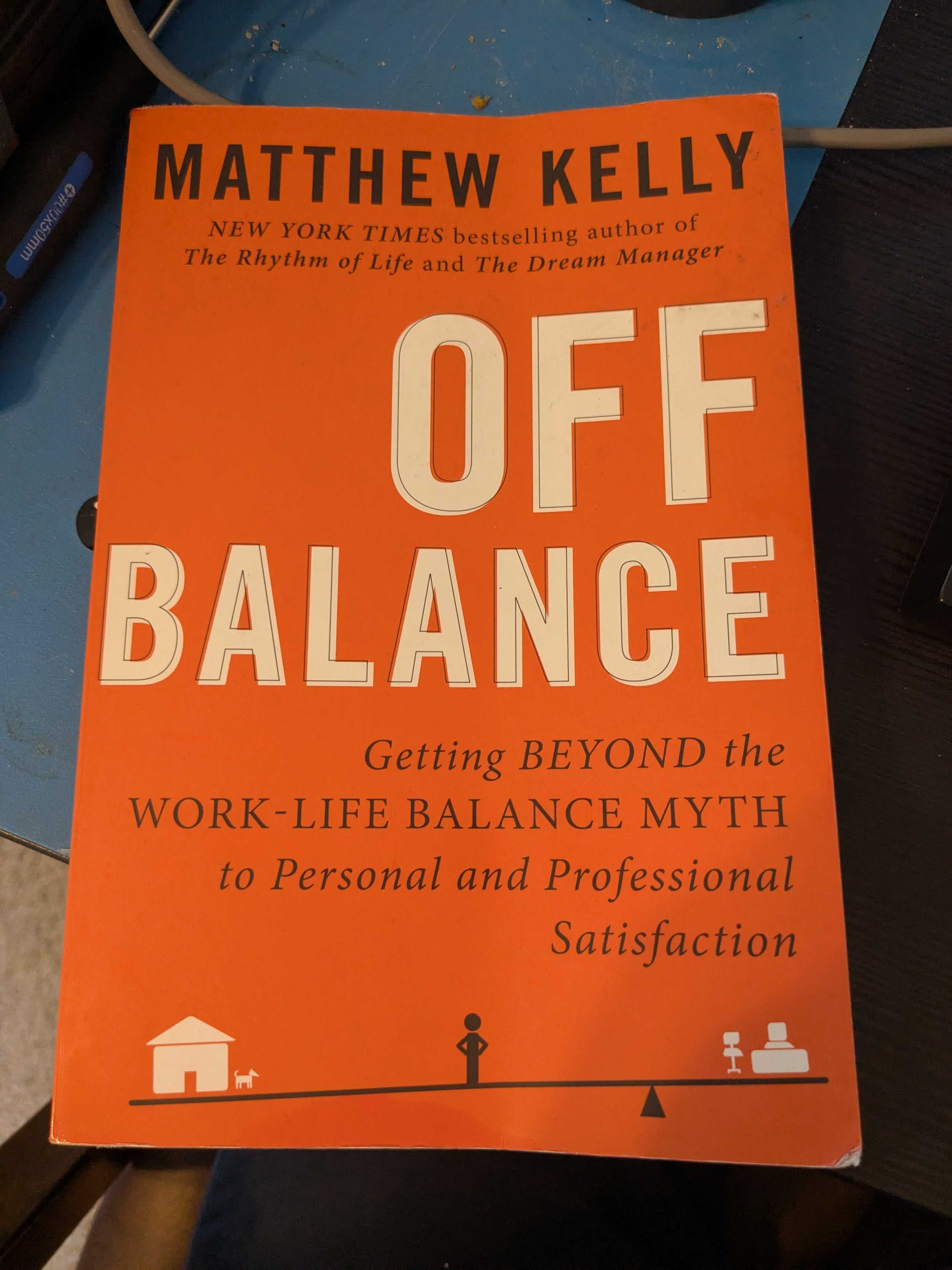
Off Balance
Getting Beyond the Work-Life Balance Myth to Personal and Professional Satisfaction
by Matthew Kelly
One Quote
I don't have balance. The good news is I now know that I don't want balance. What I do want is satisfaction. Both personally and professionally I have a very satisfying life. Am I completely satisfied? No. I don't mind telling you that I am both deeply satisfied and turbulently dissatisfied at times. But even my dissatisfaction drives me toward greater satisfaction in the future. The truth is, I work more than anybody I know, but I lead a tremendously satisfying life.
Summary
This book is all about trashing the notion that work-life balance is good. Most people are disengaged from their jobs and count the hours until the weekend. People say they want more work-life balance, but that just means they want "less work". Nobody says "I need more work-life balance, so I should work harder!". The author says "It is impossible to completely separate the personal from the professional; they are deeply intertwined." Besides, the most satisfied individuals surveyed were the ones who worked the most. The key was to get clear on your vision and values, and live well.
It was always about satisfaction. That's what people yearn for. Sometimes that satisfaction comes from working an eighty-hour week, and sometimes it comes from lying on a beach for a few days, completely unplugged from the world of work. But most of the time, living a life that is deeply satisfying requires a strategy, daily attention, self-awareness, and discipline.
and another quote
There are many things a company can and should do to help its employees pursue satisfying lives. First and foremost is to provide a comprehensive system that drives personal and professional satisfaction. It makes sense for a company to do these things purely from a position of self-interest. Employees who approach their lives strategically are more likely to approach their work strategically. Satisfied employees are more productive, they are more creative, and they provide superior customer service. But the primary responsibility for creating a satisfying life rests with the individual.
Big Ideas
Philosophies of Society
3 philosophies of our age: individualism, hedonism, minimalism. Summed up respectively, "what's in it for me", "if it feels good do it", and "what is the least I can do, and still get XYZ".
These philosophies are a problem because they steer us in the wrong direction and discourage virtue, service, and discipline. That leads us to the remedy below.
Living Well
3 communal elements of how to live well: become the best-version-of-yourself, live with virtue, and have self control. These stand in direct opposition to the three prominent philosophies of society. Virtue is the essence of excellence (opposes minimalism), service to something bigger (opposes individualism), and having self-control (opposes hedonism). We all have our own definition of living well, but it must contain these three elements of being the best you, living with virtue, and exercising self-control.
Energy
The people with the most energy were also the most satisfied with their lives. Kelly defines 4 levels of energy: low-energy-negative (depressed, exhausted), high-energy-negative (angry, anxious), reflective-positive (mellow, content), and high-energy-positive (confident, joyous, enthusiastic). If you can increase your zest, vigor and stamina, you will have more energy. Get your steps in and dial in your fundamentals. Eat, move, sleep, breathe, focus. these fundamentals will help increase your energy levels. Eat good food, get 7-8 hours of sleep, and move your body. "The whole world yearns for energy and is attracted to the people, places, things, and activities that have that energy".
Work-Life Balance Champions
Another quote from the book:
The first thing I did was ask well-respected people within various departments at three dozen of the world's best companies to nominate who they thought was exceptional in the area of work-life balance. I was surprised how easily they pointed them out. My next step was to interview these champions of work-life balance. I interviewed dozens of them, and then dozens more. I delved into their lives, and I was surprised at how open and honest they were about their successes and challenges, both personally and professionally. I could publish a two-hundred-page thesis with my findings, but I will spare you the pain. The bottom-line finding from all these interviews is this: these people are not champions of work-life balance. They certainly are not excelling at what their peers who elected them as work-life balance champions think work-life balance is. On average these supposed champions of work-life balance work nine hours more per week than their counterparts. They work hard and long hours, and they do it intentionally. They also, for the most part, have little or no misgivings about this reality.
So why did their colleagues single them out as champions of work-life balance? The answer is because, as it turns out, with almost all of them, they have large quantities of what this book is really about - personal and professional satisfaction. They work hard, but they have a sense of satisfaction when they leave the office after a long day. This professional satisfaction is fueled by several factors: they enjoy the people they work with; they feel respected by their boss; they feel their work is making a contribution to customers' lives; they find the challenge of their work matches their abilities; and they know why they go to work each day. This last one is critical, and it provides the segue into the personal realm. You see, people don't come to work because they love their company, their work, or their boss. They may love all these things, but these are not the primary reasons they come to work. People come to work because they have dreams for themselves and for their families. And those who are achieving at high levels of personal and professional satisfaction know what those dreams are.
PS
Check out a journal note I published about the prologue of the book here: The Fisherman. Find Heroic's 1-minute summary here: Wisdom Daily - Off Balance, or for the 20 minute summary go here: Philosopher's Note - Off Balance.
